
How reverse osmosis works
The membrane, the pressure, the pre-treatment that protects it, and when to clean it.

Reverse osmosis (RO) pushes water through a membrane so fine that it holds back most dissolved salts, bacteria and organic matter. It is the most widely used way to cut the salt content of brackish water, and it is the heart of most modern drinking water, mineral water and industrial process plants.
The principle
If you put salty water on one side of a membrane and fresh water on the other, water naturally moves toward the salty side. This is osmosis. In RO the direction is reversed: a high-pressure pump pushes the salty water against the membrane, and fresh water is forced through while the salts stay behind.
The pressure has to be higher than the natural osmotic pressure of the feed. For brackish water this is usually about 10 to 20 bar. Seawater needs much more.
Three streams
- Feed water goes in at high pressure
- Membrane separates water from salts
- Permeate: clean water out
- Concentrate (reject): salty water to drain or reuse
- Permeate is the treated water. A good membrane stops about 98 to 99.5 percent of the dissolved salts.
- Concentrate carries the rejected salts away so they do not build up on the membrane.
- Recovery is the share of the feed that becomes permeate. Brackish plants commonly run at roughly 50 to 75 percent in a single stage and higher with more stages and good scale control.
What is in an RO plant
Pre-treatment
- Multigrade filter for suspended solids
- Activated carbon filter for chlorine and organics
- Antiscalant dosing
- 5 micron cartridge filter as a final guard
RO section
- High-pressure pump
- Membranes in FRP pressure tubes
- Pressure gauges, flow meters, conductivity meter
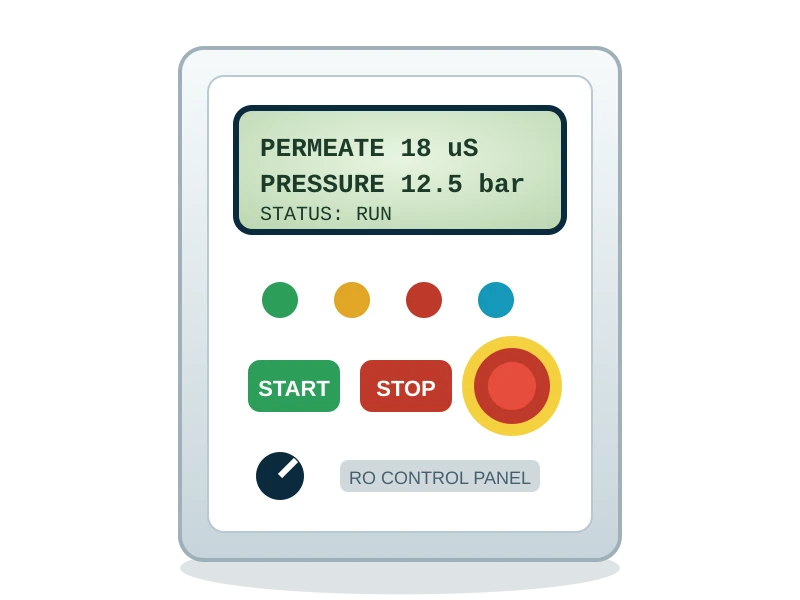
- Control panel with pressure and flow protection
Why pre-treatment matters most
The membrane is the most valuable and the most delicate part of the plant. Four things shorten its life, and pre-treatment is there to stop each of them.
| Threat | What it does | How it is stopped |
|---|---|---|
| Chlorine | Destroys the membrane material, permanently | Activated carbon or a dosed reducing agent |
| Suspended solids and silt | Coats the membrane surface | Multigrade filter and cartridge filter |
| Scale (calcium, magnesium, silica) | Crystallises on the membrane as salts concentrate | Antiscalant dosing, softening, limiting recovery |
| Biological growth | Slime that blocks flow | Disinfection of feed, regular sanitising |
Signs the membranes need cleaning
- Permeate flow falls by about 10 to 15 percent at the same pressure and temperature
- Pressure drop across the membranes rises by about 15 percent
- Permeate conductivity rises (salt passage goes up)
Cleaning is done in place with a pump, a tank and chemicals: a low pH (acid) cleaner for mineral scale and a high pH (alkaline) cleaner for organic and biological fouling. Acting early restores performance. Waiting until the membranes are badly fouled makes cleaning less effective.
What to do with the reject
The concentrate carries all the salts the plant removed, in a smaller volume. Where possible it is reused for gardening, flushing, cooling make-up or washing, and in industry it may be sent on to further treatment. Zero liquid discharge plants treat the reject to recover even more water.
Related products
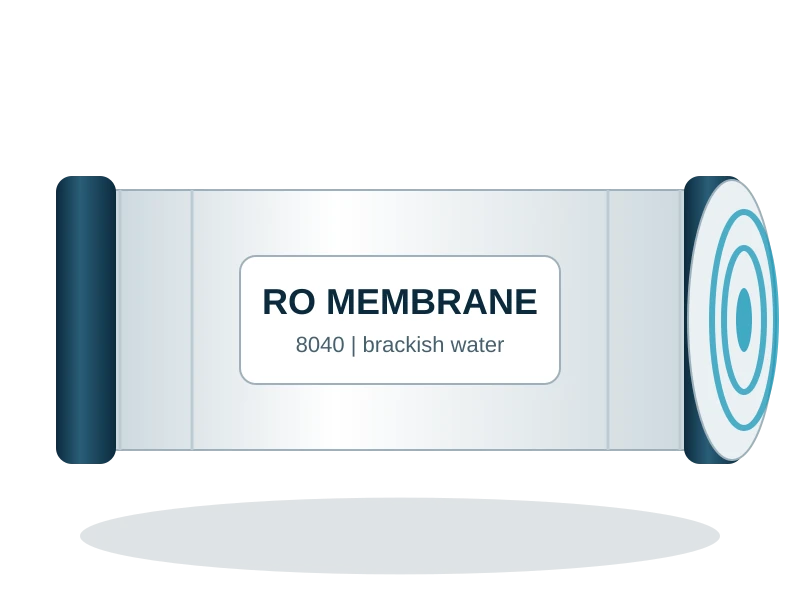 RO membraneRO plant components
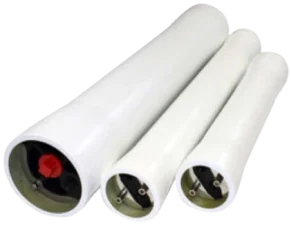 Pressure tube, FRPVessels and housings
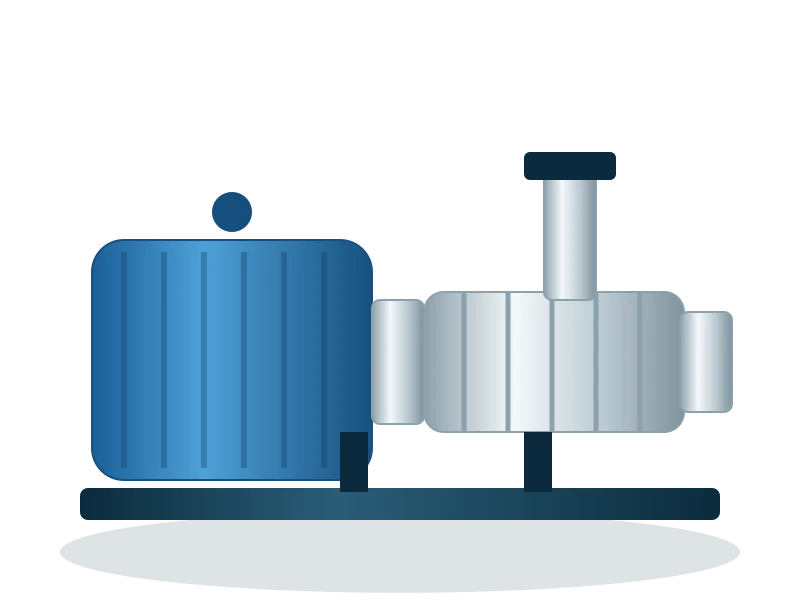 High-pressure pumpRO plant components
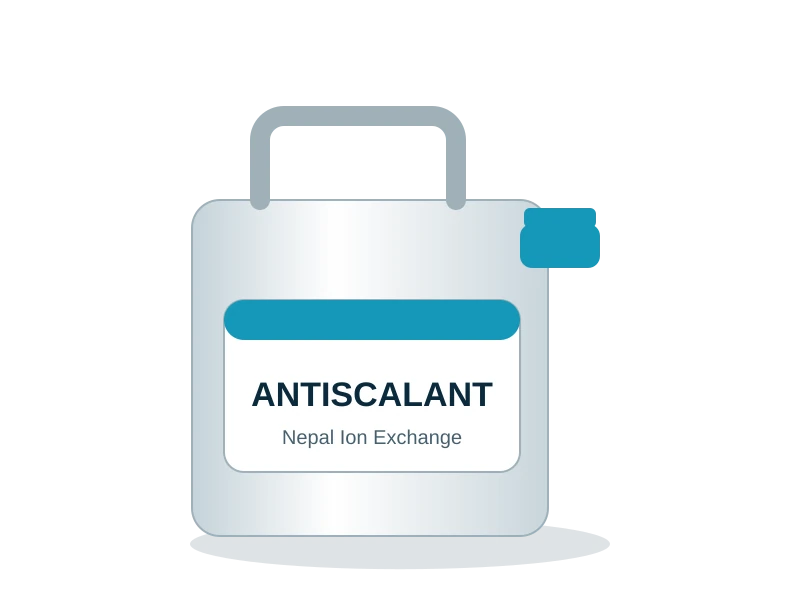 AntiscalantTreatment chemicals
 RO control panelRO plant components