
Hard water and water softening, explained
What hardness is, what it does to pipes and boilers, and how an ion exchange softener removes it.

Hardness is one of the most common water problems in industry and in homes. It is not harmful to drink, but it leaves scale in boilers, heat exchangers, pipes and kettles, and it stops soap from lathering. A softener is the usual fix.
What is hardness?
Hardness is the amount of dissolved calcium and magnesium in water. It is reported in mg/L as calcium carbonate (CaCO3). Water that has passed through limestone or other mineral-rich ground usually carries more of it, which is why groundwater is often harder than river water.
| Hardness (mg/L as CaCO3) | Description |
|---|---|
| 0 to 60 | Soft |
| 61 to 120 | Moderately hard |
| 121 to 180 | Hard |
| Above 180 | Very hard |
Two kinds are reported. Temporary hardness is linked to bicarbonate and forms scale when the water is heated. Permanent hardness comes from sulphates and chlorides and stays in the water when it boils. Both are removed by an ion exchange softener.
What hard water does
- Forms a hard crust (scale) inside boilers, which slows heat transfer, wastes fuel and can overheat the boiler metal
- Chokes heat exchangers, cooling coils and pipes
- Blocks RO membranes with scale if it is not removed or controlled
- Reduces lather, so more soap, detergent and dye are used in laundries and textile processing
- Leaves spots on glass, sanitaryware and food and beverage equipment
How an ion exchange softener works
A softener is a pressure vessel filled with strong acid cation resin in sodium form. As hard water passes down through the bed, the resin holds on to calcium and magnesium and gives off sodium in exchange. Sodium does not form scale, so the water leaving the vessel is soft.
- Hard water enters the vessel
- Resin swaps Ca and Mg for sodium
- Soft water leaves the vessel
- Resin fills up with hardness
Eventually the resin is full and must be renewed. This is called regeneration.
Regeneration step by step
- Backwash: water flows upward to loosen the bed and wash out dirt.
- Brine draw: a salt solution, commonly 8 to 10 percent, is drawn through the resin by an ejector. The sodium pushes the calcium and magnesium off the resin.
- Slow rinse: the brine is pushed through slowly so it has time to work.
- Fast rinse: fresh water washes out the salt and the removed hardness to drain.
- Service: the vessel returns to making soft water.
Multiport valves put all these steps into one valve body, so a plant can run them by hand or automatically on a timer or on the volume treated.
How a softener is sized
Sizing starts with three numbers: the flow rate you need, the hardness of the raw water, and how long you want the softener to run between regenerations. Multiply hardness by the water treated in a cycle and you get the hardness load the resin has to hold. The resin volume is chosen to hold that load, and the vessel is chosen to give the right bed depth and flow velocity.
Common softener problems
| Symptom | Likely cause |
|---|---|
| Hardness leaking through | Resin exhausted, too little salt, or channelling in the bed |
| Low flow or high pressure drop | Dirt in the bed, resin fouled with iron, or a blocked distributor |
| Resin turning brown or orange | Iron in the water coating the resin |
| Salty taste after regeneration | Short rinse or a failing valve |
Dirty, iron-rich or chlorinated water shortens resin life. A filter and an activated carbon unit in front of the softener protect the resin.
Related products
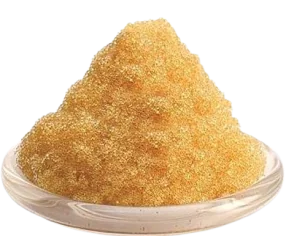 ResinMedia and resin
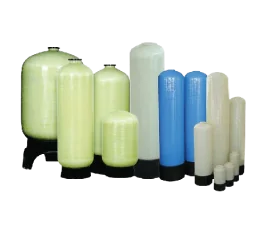 FRP vesselVessels and housings
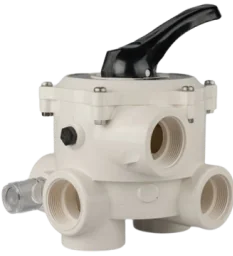 MIDAS multiport valveValves, strainers and ejectors
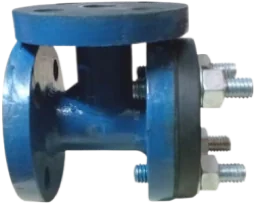 CIEL ejectorValves, strainers and ejectors