
Disinfection: chlorine, UV and ozone compared
How each method kills microbes, what it needs to work, and where each one fits.

Disinfection is the step that makes water microbiologically safe. Filtration and settling remove many germs, but only disinfection inactivates the rest. Chlorine, ultraviolet (UV) light and ozone are the three methods most often used.
Disinfection works best on clear water
Particles shield microbes from chlorine and UV light. Water should be as clear as possible before it is disinfected: low turbidity, and for UV, good transmittance. That is why filtration comes first in every treatment train.
Chlorine
Chlorine, dosed as sodium hypochlorite, bleaching powder or chlorine gas, kills bacteria and viruses and leaves a residual that keeps protecting the water in storage and pipes. Contact time, pH and turbidity all affect how well it works.
- Low cost and easy to dose with a metering pump
- Residual protection in the distribution system
- Can leave a taste and smell, and forms by-products with organic matter
- Does little against some parasites such as Cryptosporidium
A commonly used guide is a free chlorine residual of at least 0.5 mg/L after 30 minutes of contact at a pH below 8, and at least 0.2 mg/L at the point of delivery.
Ultraviolet (UV)
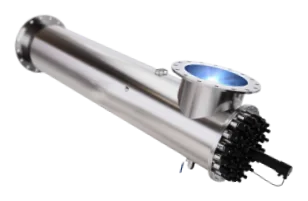
Water flows past a UV lamp inside a stainless steel chamber. The light damages the genetic material of microbes so they cannot reproduce. A dose of about 40 mJ/cm2 is the common design figure for drinking water.
- No chemicals, no taste and no smell
- Effective against bacteria, viruses and many parasites
- Leaves no residual, so recontamination after the unit is possible
- Needs clear water, a clean quartz sleeve and a lamp changed about once a year
Ozone
Ozone is a very strong oxidant made on site from air or oxygen. It kills microbes quickly, and also helps remove colour, taste, odour, iron and manganese.
- Very fast and powerful
- Leaves no lasting residual, as it breaks back down to oxygen
- Higher cost and needs careful handling and monitoring
- Common in bottled and mineral water plants
Where bromide is present in the water, ozone can form bromate, so the water quality needs checking.
Side by side
| Chlorine | UV | Ozone | |
|---|---|---|---|
| Residual protection | Yes | No | No |
| Chemicals added | Yes | No | No (generated on site) |
| Taste and smell | Can affect | None | None |
| Needs clear water | Yes | Very much | Yes |
| Running cost | Low | Low | Higher |
| Typical use | Municipal, tanks, industry | Drinking and process water | Bottled water, special uses |
Many plants combine methods, for example UV for the main kill and a small chlorine dose for residual protection in the storage tank.
Related products
 UV systemPumps, UV and filters
 Dosing pumpPumps, UV and filters
 Chemical dosing tankVessels and housings
 Cartridge filterPumps, UV and filters